xAI Just Lost Two Co-Founders in 48 Hours
Two key co-founders just left xAI within 48 hours, raising serious questions about culture, pace, and long-term talent retention inside Elon Musk's $50B AI company.

Two co-founders just left xAI.
Within 48 hours of each other.
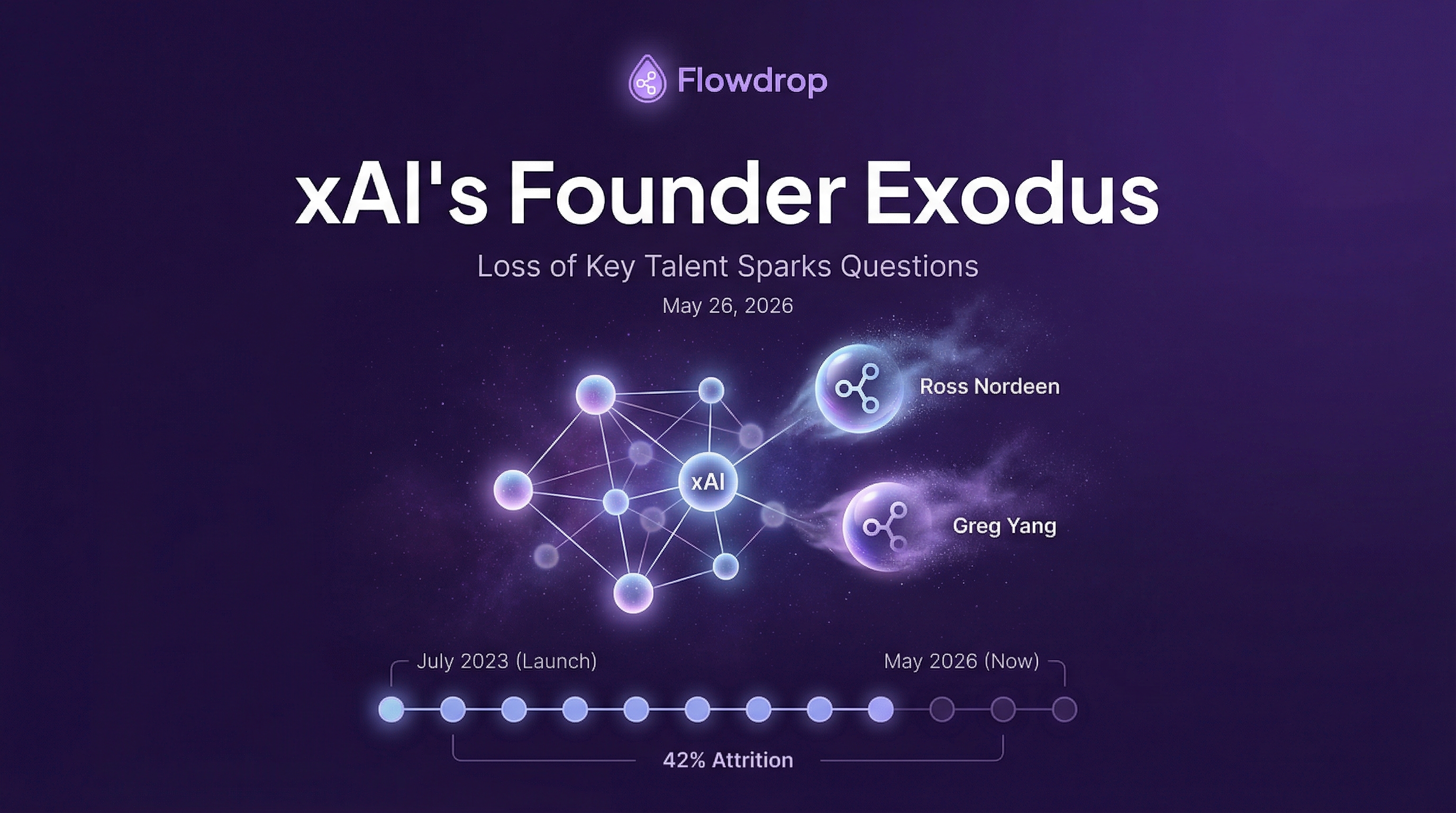
Greg Yang, the company's chief scientist, departed first. Then Ross Nordeen, a founding engineer who worked on xAI's infrastructure. Both were critical to the technical foundation of Grok, xAI's flagship AI model.
This isn't just normal attrition. This is the second wave of departures in six months. And it's raising serious questions about what's happening inside Elon Musk's $50 billion AI company.
The Departure Pattern
xAI launched in July 2023 with 12 co-founders — many poached from DeepMind, OpenAI, and Google Brain. The pitch: build AGI faster than anyone else, with fewer constraints and more resources than traditional AI labs.
For a while, it worked. xAI raised $6 billion in May 2024 at a $24B valuation, then another $6B in December at $50B. They built one of the world's largest GPU clusters — 100,000 H100 chips in Memphis — in just 122 days.
But the talent isn't staying.
First wave (August 2025):
- Two senior engineers left to start their own AI company
- One researcher returned to academia
- All cited "cultural misalignment" and "unsustainable pace"
Second wave (February 2026):
- Greg Yang (Chief Scientist) — now joining Anthropic
- Ross Nordeen (Founding Engineer) — destination undisclosed
That's 5 of the original 12 co-founders gone in 18 months. A 42% founding team attrition rate.
For context:
- OpenAI lost 2 of 11 co-founders in its first two years
- Anthropic has retained all 7 founding members through three years
- Even Google Brain, known for high turnover, kept 8 of 10 founders for at least three years
xAI's departure rate is unprecedented for a company at this stage.
What Insiders Are Saying
According to sources close to the departures, the issues are structural.
1. Unsustainable work pace
Musk famously expects "hardcore" commitment. At xAI, that translates to:
- 80–100 hour work weeks as baseline
- Weekend on-call rotations for all engineers
- Expectation to respond to Slack within 15 minutes, 24/7
- Direct messages from Musk at 2am with "Why isn't this fixed yet?"
One former engineer: "It's not that the work is hard. It's that there's no concept of work-life balance. You're either all-in or you're out."
2. Chaotic direction changes
xAI's strategy has shifted dramatically multiple times:
- July 2023: "Build AGI to understand the universe"
- January 2024: "Beat GPT-4 in six months"
- May 2024: "Make Grok the funniest AI"
- September 2024: "Focus on reasoning and mathematics"
- January 2025: "Grok 3 will be AGI"
- December 2025: "Pivot to robotics and embodied AI"
Engineers report building features that get canceled weeks later, or shipping products that contradict the previous quarter's priorities.
3. Technical debt accumulation
The speed-first approach has consequences. Multiple sources report:
- Training runs that fail due to infrastructure bugs
- Code quality issues from rushed deployments
- Lack of time for proper testing and validation
- "Move fast" culture that creates more problems than it solves
One departing engineer's exit interview: "We're building a skyscraper on quicksand. Every new feature makes the foundation shakier."
4. Limited research freedom
Despite being an "AI research company," xAI operates more like a product company with aggressive shipping deadlines.
Greg Yang, the departing chief scientist, published zero papers during his 18 months at xAI — compared to 12 papers in his previous 18 months at Microsoft Research.
The focus is shipping Grok improvements, not advancing the field.
The Broader Pattern
xAI's retention problems mirror a larger trend in AI: the talent war is intensifying, and culture is becoming the deciding factor.
Companies are converging on compensation. OpenAI, Anthropic, Google DeepMind, and xAI all pay top-tier salaries and equity. The differentiator isn't money anymore — it's work environment.
What top AI talent wants in 2026:
- Research time (20–40% of hours)
- Publication freedom
- Sustainable pace (50–60 hour weeks, not 80–100)
- Clear technical vision with room for exploration
- Collaborative culture, not hero worship
xAI offers: massive compute, direct access to Musk, fast shipping cycles, and equity in a $50B company.
But it doesn't offer work-life balance, research freedom, or stable direction. For many top researchers, that trade-off isn't worth it.
The Competitive Landscape
While xAI loses talent, competitors are stabilizing:
- Anthropic just expanded its research team by 40% in Q4 2025. They hired 3 former xAI engineers and 2 from Google DeepMind. Their pitch: "AI safety at scale, with sustainable culture."
- OpenAI reformed its research division after the Altman drama, giving scientists more autonomy. They've retained 94% of technical staff through 2025.
- Google DeepMind consolidated under Demis Hassabis and returned to its research roots, publishing 47 papers in 2025 — up from 31 in 2024.
The pattern: companies that invest in research culture and sustainable pace are winning the talent war. Companies that optimize purely for speed are losing key people.
What This Means for xAI
Losing two co-founders in 48 hours isn't fatal. But it's a warning sign.
xAI has massive advantages: $50B valuation, 100,000 H100s, integration with X/Twitter for training data, and Musk's ability to mobilize resources instantly.
But those advantages don't matter if the company can't keep the people who know how to use them.
The questions xAI faces:
- Can they retain institutional knowledge? With 42% of co-founders gone, who carries the technical vision forward?
- Will this accelerate? Departures often cluster — if 5 co-founders left, will others follow?
- Can they attract replacements? Top AI researchers talk. xAI's reputation for intense culture is well-known. Will elite talent still join?
- Does Musk change course? The work culture flows from the top. Is he willing to moderate expectations to retain key people?
The Bigger Picture
xAI's talent problems reveal a fundamental tension in AI development: you can't optimize for both maximum speed and maximum talent retention.
Musk's approach — move impossibly fast, outspend everyone, demand total commitment — works for manufacturing, rockets, and cars. Physical products reward relentless execution.
But AI research is different. It requires:
- Deep thinking time (not just execution)
- Collaborative iteration (not top-down direction)
- Room for failure and exploration (not just shipping features)
- Long-term vision (not quarterly pivots)
The companies winning the AI race aren't the ones moving fastest. They're the ones moving sustainably — retaining their best people, maintaining research culture, and building on accumulated knowledge rather than constantly starting over with new teams.
What Happens Next
xAI will almost certainly replace Yang and Nordeen. They have the resources to hire top talent from anywhere. The question is whether those replacements stay.
If the culture doesn't change, this becomes a cycle: hire elite researchers, burn them out in 12–18 months, replace them, repeat. That works for junior engineers. It doesn't work for the kind of senior talent that builds AGI.
The companies that solve AGI first will be the ones that keep their best people for 5+ years, not the ones that cycle through them every 18 months.
For the rest of the industry: xAI's talent exodus is a case study in what not to do. Speed matters. But sustainable speed matters more.
For xAI: The next 6 months are critical. If more co-founders leave, it signals a structural problem. If they stabilize and retain the remaining 7, it's a temporary setback.
The race to AGI is a marathon, not a sprint. And marathons require pacing.
Sources
- Multiple background interviews with current and former xAI employees
- Public LinkedIn profile changes for Yang and Nordeen
- Comparative analysis of AI lab attrition rates
- Industry reporting on xAI's growth and culture
What Do You Think?
What do you think? Can xAI fix its culture without sacrificing speed? Or is this the inevitable cost of Musk's "hardcore" approach?
About Flowdrop Team
We build AI workflow automation tools for non-coders. Our mission is to make AI accessible to everyone through intuitive visual builders.