The $380 Billion Question: What Anthropic's Record Raise Reveals About the AI Endgame
Anthropic closed $30B at a $380B valuation—one of the fastest runs in history. Why the AI industry is entering a capital-intensive endgame where only the richest players can compete.
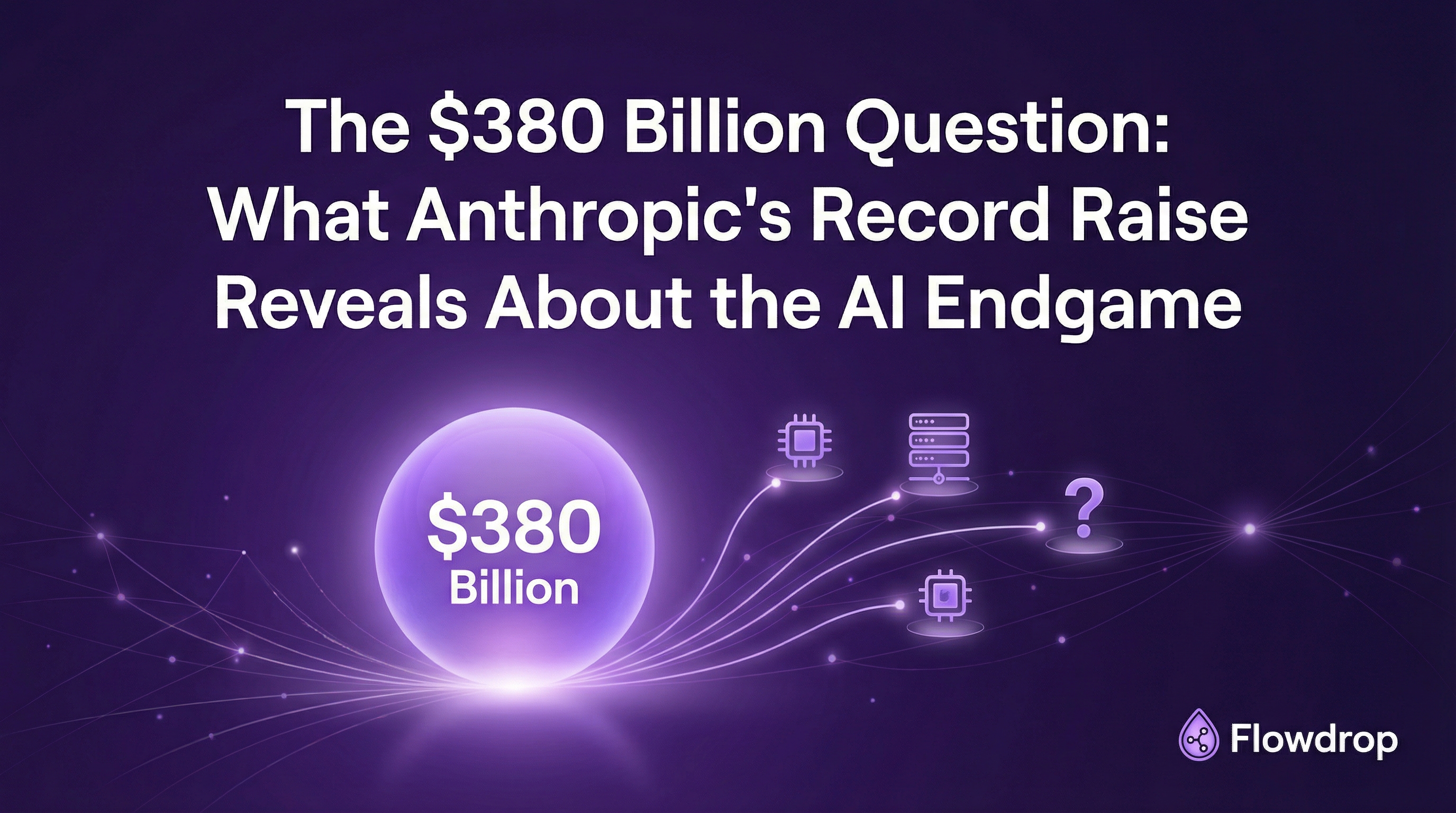

TL;DR: Anthropic just closed a staggering $30 billion Series G at a $380 billion valuation—making it one of the fastest companies in history to reach such heights. But beneath the eye-watering numbers lies a more critical story: the AI industry is entering a capital-intensive endgame where only the richest players can compete, and the definition of "winning" is becoming increasingly unclear.
On February 12, 2026, Anthropic announced what might be the most significant funding round in tech history: $30 billion in fresh capital at a $380 billion valuation. The round was led by Singaporean wealth fund GIC and Coatue, with an additional 36 investors joining the party—including heavyweights like Founders Fund, Accel, and the Qatar Investment Authority.
For context, Anthropic was founded just five years ago in 2021 by disaffected OpenAI staffers. It has now raised $57 billion total and achieved a valuation that exceeds companies like Uber, Airbnb, and most S&P 500 firms. Only OpenAI ($500B, seeking $750B) and SpaceX ($1.25T) sit higher in the private company valuation hierarchy.
The first question any rational person asks when seeing these numbers is: What exactly does an AI company need $30 billion for?
The answer reveals the fundamental economics reshaping the tech industry.
Unlike previous software booms—where marginal costs approached zero once you built the product—AI models require continuous, massive capital expenditure:
Compute Infrastructure: Training frontier AI models now costs hundreds of millions of dollars per model iteration. Anthropic's press release specifically mentions "infrastructure expansions" as a primary use of funds. They're not just renting compute—they're building private data centers and securing long-term chip supply.
The Inference Problem: Even after you train a model, running it at scale is breathtakingly expensive. Every time someone asks Claude a question, Anthropic pays real money in compute costs. At their claimed $14 billion revenue run rate, their gross margins are likely far lower than traditional SaaS companies (which typically run 70-80%). AI companies are capital-intensive businesses masquerading as software companies.
The Research Arms Race: Anthropic can't simply build Claude once and ride it for years. OpenAI releases new models. Google releases new models. The competitive moat isn't brand or network effects—it's whoever can afford to keep training bigger, better models faster.
This explains why Anthropic's 1,000-word press release—which proudly touted their $14B revenue run rate, 500+ enterprise customers, and 8 Fortune 10 clients—conspicuously avoided mentioning profitability or any path to an IPO.
Perhaps the most telling detail in Anthropic's announcement was the sheer number of investors: 36 named participants in a single round.
In traditional venture capital, this would be considered a "party round"—a red flag suggesting the company couldn't find a strong lead investor and had to cobble together capital from anyone willing to write a check.
But Anthropic isn't a struggling startup. They're one of the most sought-after companies in tech. So why 36 investors?
The answer appears to be strategic diversification. Look at who's in the round:
- Sovereign wealth funds (GIC, Qatar Investment Authority, Abu Dhabi's MGX): Long-term capital that won't demand near-term returns
- Strategic corporates (Microsoft, Nvidia): Companies that benefit from Anthropic's success regardless of equity returns
- Traditional VCs (Accel, General Catalyst, Founders Fund): Firms chasing exposure to the AI mega-trend
- Financial institutions (Jane Street, D.E. Shaw): Quantitative capital looking for asymmetric upside
This isn't a party round—it's a coalition round. Anthropic is building a cap table that can support continued mega-raises without getting squeezed by any single investor's priorities.
Compare this to OpenAI's structure, which is entangled with Microsoft's multi-billion dollar investment and compute credits. Anthropic appears to be deliberately avoiding such concentration risk.
Here's where things get philosophically interesting.
Anthropic is valued at $380 billion with roughly $14 billion in annual revenue. That's a 27x revenue multiple—stratospheric even by growth tech standards.
For comparison:
- Salesforce (mature SaaS): ~6x revenue
- Snowflake (high-growth data): ~13x revenue
- Nvidia (AI hardware king): ~18x revenue
- Anthropic (AI model provider): 27x revenue
Investors are clearly betting that Anthropic will either:
- Achieve dominant market position in a multi-trillion dollar AI market
- Discover transformative capabilities (AGI, breakthroughs in reasoning) that justify extreme premiums
- Become infrastructure (like AWS) that every company depends on
But here's the uncomfortable truth: nobody knows which of these will happen, or if any will.
AI model capabilities improve rapidly, but so does competition. Today's frontier model is next year's commodity. Anthropic's moat is its research talent and capital access—but OpenAI has more of both. Google has even more distribution and data. Meta is giving away competitive models for free.
In traditional business strategy, you build moats through network effects (social platforms), switching costs (enterprise software), or economies of scale (Amazon). AI models have weak network effects—your model doesn't improve because more people use it. Switching costs exist but are eroding as models standardize on similar APIs. Economies of scale help, but only if you can keep raising capital faster than competitors.
If you're a startup: The AI infrastructure layer is now a game for the ultra-wealthy. If your business model depends on training custom models, you're competing with companies that can light $10 billion on fire and raise another round. The only viable play is building on top of existing models (OpenAI, Anthropic, Google) and focusing on distribution, data, or specialized applications they won't pursue.
If you're an enterprise buyer: The good news is that intense competition keeps prices reasonable and innovation fast. The bad news is that your critical AI infrastructure provider might need to raise $30 billion just to keep the lights on. Enterprise buyers should be thinking seriously about vendor concentration risk and what happens if the music stops.
If you're a developer: The tools are getting astonishingly good, astonishingly fast. Claude, GPT, Gemini—they're all converging on similar capabilities. The differentiation is shifting from "who has the best model" to "who has the best integration, reliability, and specialized knowledge for my use case."
If you're an investor: The AI market is bifurcating into two categories: (1) The handful of companies with enough capital to compete at the frontier, and (2) Everyone else. There's likely money to be made in category 2, but the winner-take-most dynamics of category 1 are becoming clearer. If you believe in the AI transformation thesis, you want exposure to the companies that can keep raising at these valuations.
Anthropic's press release made no mention of profitability timelines or IPO plans. This is notable.
At $57 billion raised with a $380 billion valuation, Anthropic needs to eventually become one of the most valuable companies in the world to justify investor returns. That means either:
- Going public at an even higher valuation (requiring sustained revenue growth and a path to profitability)
- Getting acquired (unlikely—who can afford to buy a $380B company?)
- Staying private indefinitely while raising ever-larger rounds from sovereign wealth funds and strategic corporates
The third option is looking increasingly plausible. We may be witnessing the birth of a new class of company: perpetually private, capital-intensive AI labs that exist in a state of permanent fundraising, never needing to face public market scrutiny on profitability.
This isn't necessarily bad—it may be the only viable model for companies pursuing long-term AGI research. But it does represent a fundamental shift in how elite tech companies operate.
Anthropic's $30 billion raise at a $380 billion valuation isn't just a big number—it's a signal about where the AI industry is heading.
We're entering an era where building frontier AI requires nation-state levels of capital. The barriers to entry are skyrocketing. The timeline to profitability is extending. And the ultimate endgame—whether that's AGI, dominant platforms, or something else entirely—remains genuinely uncertain.
For Anthropic, the $30 billion buys them a seat at the table for the next 18-24 months. But if the AI arms race continues at this pace, don't be surprised when they're back raising another $50 billion in 2027.
The real question isn't whether Anthropic can justify its $380 billion valuation today. It's whether anyone can predict what the AI landscape will look like in five years—and whether these massive bets will look prescient or catastrophic in hindsight.
One thing is certain: we're watching the formation of the next generation of tech giants in real-time. Whether they succeed or implode spectacularly, it's going to be one hell of a ride.
What do you think? Is Anthropic's valuation justified, or are we witnessing the biggest bubble in tech history? Let me know your thoughts.
Frequently Asked Questions
About Flowdrop Team
We build AI workflow automation tools for non-coders. Our mission is to make automation accessible to everyone, so you can focus on work that actually matters.